September 22, 2026 · Lecture · LibreTimes
Algebra 1. Lecture 2
The order of an element and of a group, the order of a permutation as the lcm of its cycle lengths; generators and cyclic groups; homomorphisms and isomorphisms of groups, the classification of cyclic groups; examples — the sign of a permutation, inversion in an abelian group, the exponential, the determinant, and ; subgroups, kernel and image, the injectivity criterion; left and right cosets and the partition into them; normal subgroups and conjugation, the index, Lagrange's theorem, subgroups of index 2; the quotient group; the homomorphism theorem with examples; conjugate elements, the centre, a group action on a set.
A question before we start: what literature would I recommend? Vinberg, A Course in Algebra; it is also listed on the course page as the most basic one.
A reminder: a group is a set with one operation, usually denoted as multiplication, which is associative, has an identity element and an inverse of every element; all of this for elements of , and I will no longer write that every time. We spent the lion's share of the last class on one of the most basic examples, the symmetric group . Not in vain, I hope: the example is very important, it comes up often in problems, and today we will see that in some sense these groups describe the whole theory of finite groups – a slightly strange little theorem, but a bit later. First, a few definitions and the study of groups in general.
Order
Definition (Order of an element and order of a group). The order of an element is the smallest natural for which ; it is denoted . If no such exists, the element has infinite order. The order of a group is the number of its elements; if there are infinitely many, the order of the group is infinite.
Example (orders).
- The group of residues modulo under addition, (we will soon see that this notation has a deep meaning). It contains the element corresponding to the residue ; its order under addition is , and the group also has order . Adding the residue to itself, you get all the residues: one generates the group.
- The group : its order is , because one can go to any of elements, two to any of , and so on; by the rules of combinatorics we multiply. The orders of elements vary a lot, and there is a simple general way to compute them – see below.
- The group : one has infinite order: adding one to itself you never get zero in the integers.
Lemma (powers of an element of finite order). Let . Then if and only if is divisible by .
Proof. Divide by with remainder: , . Then , since . If , then ; but if were a natural number, this would contradict the definition: we took to be the smallest, and is smaller still. So : is divisible by . Conversely, if is divisible by , then .
The order of a permutation. Decompose a permutation into a product of disjoint cycles : one cycle of elements, another of , and so on (what we call them does not matter; what matters is that they are disjoint). We need to find the power in which becomes the identity. Disjoint cycles commute, so they can be raised to powers separately, and we need a power that kills all the cycles at once. The order of a single cycle is simply its length : shifting elements along the cycle times you come back to the starting position, and this is obviously the smallest such number. By the lemma, a power that kills a cycle is divisible by its length. A number divisible by all the lengths is their least common multiple:
Generators and cyclic groups
Definition (Generating set, cyclic group). A group is generated by a set of its elements if every element of can be written as a product of elements of and their inverses; one writes . A group is cyclic if it is generated by one element: – all its elements are positive or negative powers of (a negative power is the inverse raised to a power).
Example (generators). Last time we proved that is generated by all transpositions. The problem sheet has much nicer, small generating sets: the transpositions of neighbouring elements, , are enough, and, moreover, this whole gigantic group is generated by just two elements: the transposition and the cycle , which moves all the elements round a circle. We will not talk about this now; it is a problem on the sheet. The groups and are generated by one element – they are cyclic.
Homomorphisms and isomorphisms
Let us define maps between groups. The word "homomorphism" is so general throughout this science that it can be explained in one way for all objects in the world: it is a map that respects the structure, that is, the operations and their properties. A group has one operation, multiplication, and that is what a homomorphism must preserve.
Definition (Homomorphism). Let , be groups. A map is called a homomorphism if
the product of two elements goes to the product of their images.
Remark (the identity and inverses are preserved automatically). It might seem that one should separately require , where and are the identities of and (I name them differently so as not to confuse them). But this follows from the definition: write the equality for : , while on the left , so ; in a group one can cancel – cancel and get . Similarly, considering the equality for and we get . Preserving multiplication is enough for both the identity and the operation of taking the inverse to be respected.
Definition (Isomorphism). A homomorphism is called an isomorphism if there is a homomorphism such that and . Then one writes .
It is not necessary to require all this: it is enough for to be a bijection. An isomorphism is a bijection between the elements of two groups that respects the operation in at least one direction. (A homomorphism, on the other hand, need not be bijective at all; it simply respects the operation, and whether it is surjective, injective or anything else does not matter.)
Lemma (a bijective homomorphism is an isomorphism). If a homomorphism is a bijection, then the inverse map is also a homomorphism.
Proof. We must show that . Since is a bijection, elements of are equal if and only if their images in are equal; so it is enough to check
On the left we have . On the right, by the homomorphism rule, we get , because and are mutually inverse. We have what we need.
Theorem (Classification of cyclic groups). Every cyclic group is isomorphic either to or to for some .
Proof. Let . All elements are powers of : and (the inverse of is , and so on).
Case 1: has infinite order. Then all these powers are distinct: if with , then after cancelling we get , that is, finite order, a contradiction. Define a map , . It is a homomorphism: in the operation is addition, and by the laws of exponents (recall that the operation is not always denoted by a multiplication sign). It is bijective by what was said above.
Case 2: has order . Consider the elements . I claim that they are distinct and there are no others. is already listed; any power above too: divide the exponent by with remainder, , where is the remainder; inverses are not needed either: is exactly , its product with is , and likewise for the other negative powers. Define a map : to a residue – the set of all numbers congruent modulo – assign to that power. This does not depend on the choice of representative: if , then and differ by to a power that is a multiple of , that is, by the identity. The map is well defined, it is a homomorphism for the same reasons, and it is bijective by what was said above.
So cyclic groups may not look exactly like this, but they are isomorphic to these.
Example (homomorphisms).
- The sign. Parity gives a homomorphism : even permutations go to , odd ones to (residues modulo ). That it is a homomorphism follows from the statement proved at the end of the last lecture: the product of two even permutations is even – the equality reads (in the operation is addition); of an even and an odd one, odd, and so on: the parity of a product agrees with the addition of even and odd numbers.
- Inversion. The map , . When is it a homomorphism? For abelian groups; and then it is even an automorphism, an isomorphism of the group onto itself, since it is obviously bijective. Why abelianness is needed: the element must go to , and last time we saw that : the order of the letters has changed. That is exactly how it all works out: in the elements and stand next to each other and cancel nicely, then and ; but in an has got in between and , and nothing can be cancelled, because the property can only be used for elements standing next to each other.
- The exponential. , ; the positive reals form a group under multiplication, where you may safely divide. By the property of the exponential : the operation is respected: addition on the left, multiplication on the right. This is an obvious bijection, so ; instead of any positive base will do.
- For connoisseurs there are plenty of examples from linear algebra, for instance taking the determinant . Homomorphisms are everywhere.
- . Here is the symmetry group of the regular -gon (last time I forgot to give this notation; conventions differ: sometimes one writes by the number of vertices, sometimes by the number of elements; we will write ). Permutations of three elements are the same as symmetries of the regular triangle: a symmetry is uniquely determined by how it permutes the vertices, and they can be permuted in any way – every permutation gives an isometry preserving the triangle. But and are not isomorphic at all: in a square you cannot keep two vertices in place and swap the other two – a square cannot be twisted like that. is smaller.
Subgroups, kernel and image
Definition (Subgroup). A subset is called a subgroup if it is itself a group with respect to the same operation.
This matters. is a subgroup of , and is a subgroup of . A non-example: , the nonzero rationals under multiplication, is not a subgroup of : as a subset it does lie there, we have just thrown out zero, but the operations are completely different.
To check that a subset is a subgroup one has to check closure under the operation (that the operation is defined at all) and the presence of the identity and of inverses. Associativity need not be checked: it holds in the whole big group, and hence in the small one.
Definition (Kernel and image). Let be a homomorphism. Its kernel and image are
the kernel is everything that goes to the identity; the image is those elements of to which at least something goes.
Theorem (The kernel and the image are subgroups). is a subgroup of , and is a subgroup of .
Proof. The kernel. Take and check that ; we will see in a moment why checking exactly this is a little quicker. Apply : : the product has been split and the inverse taken out by the property just proved; both factors are the identity, so the product is the identity too. Everything else follows from this one property. The kernel is nonempty: the identity goes to the identity. Put , arbitrary: lies in the kernel, so inverses are there. Now put in place of the element , which, as we have just understood, lies in the kernel: (taking the inverse twice is the same as not taking it at all); products are there. Do not check the product and the inverse separately: the one property is enough, the other two follow from it.
The image. More or less the same: if and , then is also in the image.
Example (kernels).
- From any group to any group all elements can be mapped to the identity. This is a homomorphism (a product goes to a product), but of course not an isomorphism. The kernel is the whole group.
- , assigning to an integer its residue: all numbers divisible by go to zero; the kernel is infinite, it is . Kernels vary a lot and are most likely nontrivial.
- The sign for : the image is everything (there are even and odd permutations), the kernel is the group of all even permutations; it is denoted and is a very, very important subgroup of .
- Squaring , : a homomorphism, because multiplication is commutative, . The kernel is (there is no zero here at all), the image is the positive numbers: they are exactly the squares of reals.
Theorem (Injectivity criterion). A homomorphism is injective if and only if its kernel is trivial: .
The kernel cannot be empty: the identity always lies in it; but it may happen that there is nothing else, and this is equivalent to different elements going to different elements.
Proof. Suppose two elements go to the same one: . Let us not skip steps: this is equivalent to , which by the homomorphism law collapses into , which by definition is equivalent to . If the kernel is trivial, this element is the identity and . And conversely: if the kernel contains a nontrivial element, other than the identity, then there are going to the same element.
So injectivity is very easy to check: there is no need to think about whether some two elements might be glued together; it is enough to see that only the identity goes to the identity.
Cosets
Definition (Cosets). Let be an arbitrary subgroup and . The left coset is
all the elements of the subgroup multiplied on the left by one and the same . Similarly, the right coset is . The set of left cosets is denoted .
Is a subgroup? Almost never: only if , and then : if you multiply all elements of the subgroup by an element of the same subgroup, you get a subset of (closure), and in fact all of (there are inverses). Otherwise a coset has no structure at all – it is just a set.
Theorem (Cosets are either disjoint or equal). Two left cosets are either disjoint or equal; moreover,
The same holds for right cosets (with the condition ).
Choose at once, left or right: only left cosets among themselves are either disjoint or equal, and only right ones among themselves; a left and a right coset can intersect in a very nontrivial way. Different elements can give the same coset: for instance, any two elements of give itself.
Proof. Suppose the cosets intersect: there is an element lying both in and in . By definition this means for some . Multiply on the left by : ; then on the right by :
On the left is an element of (it is a subgroup), so ; call it . Now write out the coset and show that it equals : insert ,
we substituted , cancelled and remained; and runs over all elements of as runs over all of them: if you multiply all elements of a group by a fixed element, you get all elements of the group. So if the cosets intersect, they are equal, and at the same time . Conversely, if , the same computation shows that the cosets are equal.
So the whole group is partitioned into disjoint left cosets: some coset , some , and so on.
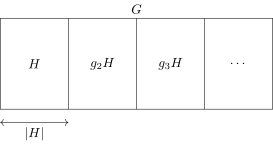
The group partitioned into the left cosets of the subgroup ; each coset has elements, and there are cosets.
Normal subgroups
A super-important situation.
Definition (Normal subgroup). A subgroup is called normal if one of the following equivalent conditions holds:
- for every , that is, the left coset equals the right one;
- for every ;
- for every .
The operation for a fixed is called conjugation; the second condition says that conjugation by any element preserves the subgroup . The third condition is weaker, but it is enough: the reverse inclusion follows automatically (an easy exercise). Equivalence of 1 and 2: if as sets, multiply both on the right by – equal sets stay equal: . Conversely, multiply on the right by .
Example (normal and non-normal subgroups).
- In an abelian group every subgroup is normal: elementwise, not only as sets.
- has both normal and non-normal subgroups. The three-element subgroup is normal; this is a consequence of a more general statement below. The subgroup is not normal: conjugate by the transposition and you will see that you do not get what you had, simply because they do not commute.
Definition (Index). The index of a subgroup is the number of elements in the set of left cosets .
Theorem (Lagrange's theorem). If are finite groups, then
Proof. The simplest combinatorics: the group is partitioned into disjoint cosets, there are of them, and each has elements: if you multiply all elements of the subgroup by a fixed element, you get as many elements.
The subgroup has index : it has three elements, and has six.
Theorem (A subgroup of index 2 is normal). Every subgroup of index is normal, whether the group is finite or not: if there are only two left cosets, the subgroup is normal.
Proof. Let and take . If , the left coset is just , and for the same reason the right coset : they agree. If , then the whole group is split into two left cosets, one of which is , and the other is everything that is left: , the complement. The right coset is exactly the same complement. The left and right cosets simply have nowhere to go but to coincide: is both a left and a right coset, and so is the complement, and for the same elements.
The quotient group
Why do we need normality? For a very important notion.
Theorem (Quotient group). Let be a normal subgroup. Then the set has a group structure:
This group is called the quotient group (factor group) of by .
Proof. Introduce a multiplication on cosets: there is a coset with an element and a coset with an element ; the element also lies in some coset, and we want to call that coset the product. One can always write this; the problem is that a coset determines its element non-uniquely – any element of the coset determines it – and one has to check that the definition is correct: whichever representative is taken, the same coset results. That is, one has to show that the pairwise products of all elements of the first coset with all elements of the second give exactly the elements of one fixed coset:
where on the left is the set of all products. The subgroup is normal, so the right coset equals the left one :
because all possible products of elements of the subgroup with elements of the subgroup are all the elements of the subgroup. Everything is proved: the multiplication is well defined, and the group axioms are inherited from .
Cosets are not subsets of the group or elements of ; they are regarded as elements of a new set; this is a common misconception. Moreover, the quotient group by no means always embeds in any natural way even in the original group.
Example (quotient groups).
- has the subgroup of numbers divisible by . What happens if we take the quotient? A left coset here means: take a number and add all numbers divisible by : this is exactly a residue class modulo , and the operation on cosets is the same as on residues, simply by construction. So is the quotient group of by , and the notation from the last lecture did not come about by chance: it is a quotient.
- : the subgroup is normal as a subgroup of index , and the quotient is a group of two elements, and there is only one such: .
The homomorphism theorem
Theorem (Homomorphism theorem). Let be a homomorphism. Then:
- is a normal subgroup of ;
- , and canonically so.
"Canonically" is a word that is hard to define; on the whole it means "naturally, not depending on any choices": we will construct a map, and it will be clear that it is natural. (The isomorphism sign, with two strokes or one, does not matter.)
Proof. Part 1. Check the third condition of normality: for every . Take and apply to ; is a homomorphism, so expand:
because lies in the kernel and . The inclusion holds; the subgroup is normal.
Part 2. Take a coset . All its elements go to the same element under : for we have . We need a map from cosets to ; it is natural to assign to a coset this common image:
We have just seen that this is well defined. It is a homomorphism: the coset goes to , and by definition this is , the same thing; respects the operation because of how it is constructed and because was a homomorphism. Bijectivity: surjectivity: the image of coincides by definition with the image of , and a map onto its image is always surjective; injectivity: only the trivial coset, the kernel itself, goes to the identity, simply by the definition of the kernel. Injectivity and surjectivity are direct consequences of the definitions of the kernel and the image, and that is all.
Example (the homomorphism theorem).
- , reducing a number modulo : the kernel is , and the theorem says that is the quotient by , as we saw.
- is surjective with kernel : once again we get .
- In , the symmetry group of the regular -gon, there is the cyclic subgroup of all rotations. It is normal as a subgroup of index : there are rotations and reflections, and the rotations make up exactly half; or because rotations preserve orientation and reflections do not, and conjugation preserves orientation-preservation. The quotient is .
Conjugacy, the centre, actions
Time is more or less up; to finish, a couple more definitions, not least so that you can solve the last problems on the sheet.
Definition (Conjugate elements). Elements are conjugate if there is a such that .
This is an equivalence relation: if is conjugate to , then is conjugate to ; if is conjugate to and to , then is conjugate to . The group is partitioned into disjoint conjugacy classes, in each of which all elements are conjugate to one another. What is the class of the identity? Only the identity itself: substituting one, and cancel nicely. When does the class of an element consist of that element alone? When it commutes with everything: then in one can swap and , and remains. For example, in an abelian group every element commutes with everything.
Definition (Centre). The centre of a group is the set of elements that commute with all elements of the group.
Definition (Group action on a set). Let be a group and an arbitrary set. acts on if we are given a map to the group of bijections of onto itself such that
Here is the group of bijections of the set onto itself, by analogy with permutations, only the set is completely arbitrary. It follows automatically from the definition that the inverse element acts by the inverse map. Each element of the group transforms somehow, and the identity acts as the identity, while a product acts by the composition. (A question from the audience about the order of the factors in the composition – we will discuss it later.)
Why do we need actions on sets? To study, for example, the automorphism groups of various objects. A problem: prove that the rotation group of the cube is . Find the four objects that the rotation group of the cube permutes, and prove that this gives an isomorphism.
No comments yet
Be the first to share your thoughts.