September 22, 2026 · Lecture · LibreTimes
Topology 2. Lecture 1
Why homology is needed — the fundamental group as a functor, homotopy groups, bordism and its combinatorial approximation; chain complexes and their homology; abstract simplicial complexes, geometric realisation and triangulations; the complex of simplicial chains, the proof of , the simplicial homology of a segment, of two points and of the boundary of a triangle; reduced homology.
Why homology is needed
This is a course in algebraic topology: we take a topological space and assign an algebraic object to it in order to study it. We will begin with homology theory – we will build from spaces algebraic objects called chain complexes and compute their homology. Why chain complexes are built is a priori unclear: topology was invented by Poincaré, he had homology, but he did not have chain complexes. So first, some motivation.
You already know one such invariant: the fundamental group. To a space with a basepoint one assigns the group : classes of maps up to homotopy preserving the basepoint. An element of the group is a loop, and two loops define the same element if one can be continuously deformed into the other with the basepoint staying in place.
This assignment is a functor from the category of pointed spaces to the category of groups: a continuous map defines a homomorphism , compositions go to compositions, and the identity map goes to the identity homomorphism. It follows at once that isomorphic objects go to isomorphic ones:
- if (homeomorphic), then .
Moreover, homotopic maps induce equal homomorphisms: if , then . So objects that are isomorphic already in the homotopy category have isomorphic fundamental groups:
- if (homotopy equivalent), then .
You should know all this. This way you can tell the letter B from the letter D up to homotopy equivalence, but not A from D: they are homotopy equivalent. One also sees the shortcoming of this invariant: it is one-dimensional. We map something one-dimensional into and notice only one-dimensional holes; is trivial, and we cannot tell the two-dimensional sphere from the plane. But we want to distinguish higher-dimensional spaces, and for that we need higher-dimensional analogues of the fundamental group. There are three well-known ones.
Homotopy groups. They are defined in the same way, only instead of the circle one takes the -dimensional sphere: is the set of homotopy classes of maps . For this is an abelian group. They are important and hard; we will understand why they are important and learn to compute them a little, but we will not get far – a much more complicated technique is needed. Even the homotopy groups of spheres have not been computed to this day.
Bordism groups. The circle is the only connected compact one-dimensional manifold, so the picture with a loop can be generalised differently: consider continuous maps of smooth compact -dimensional manifolds without boundary, up to the relation of bordism. Two maps and are bordant if there is a manifold with boundary of dimension , a "film", with , and a map whose restrictions to the boundary are and . One gets a group ; we will not study it. It took people a long time to learn to work with these groups. The difficulty of the problem can be judged by putting a point in place of : this is the classification of smooth manifolds up to bordism, and it was done by René Thom around 1950, fifty years after the idea Poincaré had.
Homology groups. In essence, a combinatorial approximation of the bordism groups. The same thing happens, only everything is cut into polyhedra, triangulated: elements of homology are continuous maps into of triangulated analogues of manifolds (pseudomanifolds), up to an analogue of bordism called homology. How is this idea realised in practice? We cut a polyhedron into the simplest polyhedra, simplices, the -dimensional analogues of a triangle. Then a map into is a linear combination of images of simplices with coefficients , adjoining each other in the right way. The condition "no boundary" is formalised by the operator of taking the boundary, in which the signs are arranged so that boundaries cancel where one sees geometrically that they cancel: the boundary of a segment is one endpoint minus the other, and if you add the three sides of a triangle, everything cancels. So "without boundary" means that the boundary operator vanishes on it. And the equivalence relation: the difference of two objects is someone's boundary. The bottom line is that all our invariants, "something up to something", are written as a kernel modulo an image.
It was Poincaré who gave the definition of homology and said that it was bordism; that is roughly how it was, but nothing was proved in his papers; the methods of combinatorial approximation were invented later by people in order to prove rigorously what he had. He was a great visionary.
Chain complexes
We turn to a purely algebraic definition.
Definition (Chain complex). A chain complex is a sequence of abelian groups , , and homomorphisms lowering the grading by one,
such that : all double composites are zero homomorphisms. The homomorphism is called the differential, and the elements of are -dimensional chains.
Instead of abelian groups one can take vector spaces over a field with linear maps, modules over a ring with homomorphisms linear over the ring; in general this is done in abelian categories. For now everything will be for abelian groups.
Definition (Homology of a chain complex). For an integer , the -th homology group of the complex is
the quotient of the group of cycles by the group of boundaries .
The definition is correct: the condition is equivalent to the fact that applying to anything lands in the kernel of , that is, .
Remark (graded notation). The family of groups can be regarded as one graded abelian group , the elements of having degree ; then is a graded map of degree , and are graded subgroups, and is the quotient of a graded group by a graded subgroup, for all at once. The star always denotes a graded object. (In Russian the word for homology is practically never used in the singular; the one exception is the Russian translation of Mac Lane's book Homology.)
Example (complexes with one and two groups). A completely boring example: all groups are zero except one: . This is a chain complex (the composite of any two differentials is zero), the kernel at is all of , the image is zero, so the homology looks the same: in this degree and zeros in the others.
A little more interesting are two nonzero groups in a row: . Also always a complex. In the degree of one has to take modulo the image of the zero homomorphism; in the degree of , the kernel of the zero homomorphism, that is, all of , modulo , and that is the cokernel . Altogether the homology is: , , zeros elsewhere.
Example (a complex without homology). , where is included as the first summand and then everything is projected onto the second. There is no homology; a simple exercise. This is not the only example: from three groups one can build a chain complex without homology that is not of this form; also an exercise. Complexes without homology are called exact sequences.
How should one think about an element of a homology group? It is an element of the quotient group : it has a representative upstairs and there is an ambiguity. Every can be written as , where is a cycle, , and itself is defined up to adding someone's boundary:
It is important to remember and fix: we never write if is not a cycle. Such notation already implies that in the complex we are working with.
Geometrically we think of a cycle as something -dimensional without boundary, made up of -dimensional simplices; two cycles are homologous if the difference between them can in some sense be triangulated. Instead of simplices one could build the whole theory by cutting the space into cubes; it is just inconvenient for algebraic reasons.
Chain complexes form a category; its morphisms are called chain maps, there are analogues of homotopies, a tensor product; all later.
Abstract simplicial complexes
For now we will assign chain complexes not to arbitrary spaces but only to spaces cut into simplices; then it is clear how to map simplices there: embed them, that is all. Such spaces are built in different ways: simplicial sets, semi-simplicial sets, simplicial complexes. We will work with simplicial complexes: the most restrictive option, but the clearest, and easier to compute with on a computer. They are so combinatorial by nature that they are encoded in the language of families of sets.
Definition (Abstract simplicial complex). Let be a set (the vertices). A simplicial complex on the vertex set is a nonempty family of finite subsets of satisfying one axiom:
An element is called a simplex (or face) of the complex; its dimension is .
Geometric, isn't it? We think of a simplicial complex as something cut into simplices of various dimensions: points, segments, triangles, tetrahedra. The idea of the encoding: where there is a simplex, say the triangle , we put this set into the family; and if an edge belongs to the complex, its vertices must too, so we add all subsets.
Example (a complex on six vertices). ; consists of the triangle , the segments , , , the vertex and all their subsets. Then , while . Formally it follows from the definition that ; this is convenient for some reasons and inconvenient for others; . A point, a one-element set, is zero-dimensional; a segment, a two-element set, is one-dimensional, and so on.
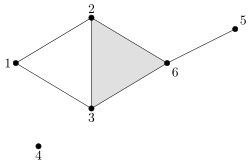
The complex on the vertices : the shaded triangle , the edges , , , the isolated vertex , and all subsets of these.
One can additionally require that all one-element subsets lie in , that is, simply throw out the superfluous vertices; sometimes it is convenient not to require this. In this way a fairly clear "hand-made" space is encoded by finite combinatorial data, convenient to feed into a computer.
Geometric realisation
Now we must learn to assign a topological space to a complex. One way: place the vertices in a space of sufficiently high dimension and take convex hulls; on a line this will not work, one needs dimension at least two so that the segments do not intersect. Most convenient is to take the points as independent as possible, the ends of the basis vectors: then certainly nothing will intersect anything unnecessarily.
Definition (Geometric simplex, geometric realisation). Consider the vector space with a basis indexed by the vertices. For a finite the geometric simplex is
the convex hull of the ends of the basis vectors, regarded as a topological space. The standard -dimensional simplex is .
The geometric realisation of a simplicial complex is
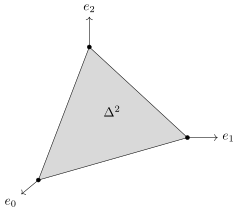
The standard simplex , the triangle spanned by the ends of the basis vectors in .
The example with six vertices cannot be drawn this way; it has to be embedded in six-dimensional space. But if on the vertices , then inside one has to pick the edge and the point ; their union, a segment and a point, is the geometric realisation of .
Remark (the topology on). If is infinite, the infinite direct sum is covered by finite-dimensional subspaces, and one takes the union (colimit) topology on it. For simplicity one can assume finite (in practice it will be), but there is no need to fear the infinite case: the plane can be cut into triangles and described quite combinatorially, and the geometric realisation will be homeomorphic to the plane.
Definition (Triangulation). A triangulation of a topological space is a pair: a simplicial complex and a homeomorphism .
Some spaces can be triangulated, some cannot.
Example (the circle and the sphere). How many vertices are needed to triangulate the circle? Three: the boundary of a triangle, the complex on three vertices consisting of all edges and vertices; its realisation is homeomorphic to . On two vertices it is impossible: there are very few complexes on two vertices at all (two points, a point, a segment), a two-element set has no other subsets. A "digon", the boundary of a digon, is not a simplicial complex. For the two-dimensional sphere four vertices are needed, the boundary of a tetrahedron; on three vertices, going through all complexes, you will not find a sphere.
Using homology one can show that triangulating a two-dimensional surface requires a number of vertices growing roughly like the square root of the number of handles. This is a well-studied question, but there will be a problem about it on the sheet.
Simplicial chains
To assign a chain complex to a simplicial complex we need orientation. I do not want to talk about what orientation is (you are not ready for that conversation), so from this point on is linearly ordered. This has two bonuses; one today, the second next time.
The first bonus: if is a face of dimension , that is, , there is a distinguished bijection : the smallest element of corresponds to zero, the next one to one, and so on. It defines a canonical homeomorphism . This is useful: having met a triangle in nature, one can build a linear homeomorphism from the standard triangle onto it in many ways ( to any of the three vertices, to either of the remaining two), and if your friend finds the same triangle and orders the vertices differently, there will be communication problems. With ordered vertices there is a distinguished object.
In addition, for the set of elements of smaller than is well defined:
Definition (The complex of simplicial chains). For the group of -dimensional simplicial chains is the free abelian group with basis indexed by the -dimensional simplices , ; for we put . The differential is given on the basis by the formula
The resulting chain complex is called the complex of simplicial chains of , and its homology
the simplicial homology of the complex .
The meaning: an element of is a formal linear combination of -dimensional simplices, this triangle five times plus that one minus seven times (physicists had fun at this point: how can there be minus seven triangles?). The boundary of a triangle must be a linear combination of its sides with signs chosen so that the common segment of two adjoining triangles cancels. That is exactly what the signs , the Koszul signs, do.
The empty face of dimension is ignored in this definition: it has no geometric meaning: where do you see it? Outside all dimensions. We will come back to it.
Theorem (Correctness). with the differential is a well-defined chain complex.
Proof. The formula defines a homomorphism. A homomorphism from a free abelian group is determined by its values on a basis: every element of is uniquely written as a finite combination with integer , and extends by linearity.
The right-hand side lies in . Let , . Then , so by the axiom of a simplicial complex, and , so is a basis element of the right group. Without the definition of a simplicial complex this would not work.
. It is enough to check on a basis element. The differential is linear, so
This is a sum over ordered pairs of distinct elements of ; group it by unordered pairs . The pair arises twice: for , with the exponent
and for , with the exponent
The set consists of the elements of smaller than with thrown out (and , so was there): . The set consists of the elements of smaller than , and was not among them: . The exponents are and , of different parity. So each has the coefficient , and the whole frightening expression is zero.
So, the pipeline: there is something triangulated; we record the sets of vertices spanned by simplices; we build free abelian groups and very simply defined homomorphisms between them; then we compute kernels and images and take quotients. This is a problem of elementary linear algebra: bring the matrices to Smith normal form. Tedious: computing even the homology of the Möbius band this way is real work. We will not do it directly; in the end we will prove theorems that make computing homology much simpler. But for now we have to sort this out; we are in no hurry.
Remark (homology with coefficients). Instead of one can put any abelian group : , a direct sum of copies of , the differential by the same formula, and get homology with coefficients in , . Over it is easier to compute, but some information is lost. At the end of the course we will understand that, having computed over , we can compute over anything; this is the universal coefficient theorem: is universal. On a computer one computes over finite fields, and, so as not to lose anything, over fields of all characteristics.
Examples of computations
Example (the segment). is the segment with vertices : . The chain complex is concentrated in dimensions and :
By the formula: throwing out we get the sign , throwing out the sign , altogether
the matrix of the differential is . It has no kernel, and the image is generated by . So
the free group generated by the class .
Geometrically: a point has no boundary, it is a zero-dimensional cycle, and each of the two points gives a class in homology. But these classes are equal, because the cycles are homologous: the segment is an object with boundary, its boundary is the second point minus the first, and it provides the equality. There are no one-dimensional classes: has no one-dimensional holes, only a zero-dimensional one, and just one.
Homology is usually written left to right in increasing degree, and chain complexes in decreasing degree, because the differential lowers the degree. This is a little confusing.
In general, for an edge , ,
For a triangle with vertices
Why these signs? Draw arrows on the edges in increasing order of the vertices, and on the triangle counterclockwise. The edges and go in the same direction as the walk round the triangle, while goes the opposite way, so it has a minus. The facet that does not contain the smallest vertex always enters with a plus (its sign is given by the cardinality of the empty set), and after that the signs alternate.
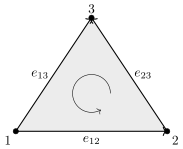
: going round counterclockwise, the edges and are traversed along their arrows, the edge against it.
Remark (order and orientation). Giving an order on the vertices is, in a sense, exactly giving an orientation: once the order is given, there is a canonical identification of each face with the standard simplex. In geometry, orientation is about which linear operators are connected to the identity by a path and which are not; here it is the same: two numberings of a face differ by a permutation of the vertices, and the sign is the parity of the permutation.
Simplicial homology does not depend on the choice of the linear order; this can be checked by hand, but it is not very instructive: swap two vertices and the differential gets messed up. A stronger announcement: if two simplicial complexes have homeomorphic geometric realisations, then their simplicial homologies are isomorphic. This theorem cannot be proved without singular homology: if one space is triangulated in different ways, it is by no means clear that the triangulations can be refined compatibly. The proof goes like this: introduce the singular homology of any topological space, purely in terms of topology, and prove that for a triangulated space it coincides with the simplicial homology of the triangulation. That is next time.
Example (two points). Throw the edge out of the segment: . disappears from the chain complex, remains with the zero differential, and
The two zero-dimensional cycles are now not connected by anything; there are no linear relations between them.
Example (the boundary of a triangle). The complex on the vertices consisting of all edges and vertices is a circle. The chain complex: with basis , with basis , and by the formula for edges
(the columns are the images of ). is the kernel of this matrix, the cokernel. By row and column operations (changes of basis in and , which do not change the homology) the matrix is brought to the diagonal form : this is the Smith normal form, and any map can be brought to it. The kernel is one-dimensional, the cokernel is . In the original bases:
where . The one-dimensional cycle, a linear combination of edges with zero boundary, is, as one would expect, the walk round the triangle.
Reduced homology
Let us come back to the empty face.
Definition (Reduced simplicial chains and homology). The complex of reduced simplicial chains is defined by the same formula, but the empty set is not ignored: is the free abelian group on all faces of dimension for any . Little has changed: one basis vector has been added,
The differential is called the augmentation; by the formula for each vertex – all basis elements are sent to one, very boring. The reduced simplicial homology is
Example (the segment and two points, reduced). For the segment the reduced complex has the form
, . The kernel of is generated by , that is, ; is surjective, the cokernel is zero; is injective. All the reduced homology of the segment is zero.
For two points disappears, the image of kills nothing, and what remains is
In general, if the complex has at least one vertex, is surjective (the boundary of a vertex is the empty simplex, and the empty simplex dies), so homology in degree usually does not occur.
Geometrically, reduced homology ignores the class in zero-dimensional homology that is always there and is a bit annoying: one wants a space homotopy equivalent to a point to have no homology. For reduced homology this is true, for the ordinary one it is not. Later we will see that reduced homology is in some sense homology relative to a point.
Next time, singular homology.
No comments yet
Be the first to share your thoughts.