September 22, 2026 · Lecture · LibreTimes
Geometry. Lecture 2
Finite geometries — the Platonic solids. A reminder — right actions, orbits, stabilisers, fundamental domains (corrected definition) and the example of on the plane; the formula and the 48 symmetries of the cube; regular polyhedra — Sosinsky's definition and the definition via flags, a stellated counterexample; the five Platonic solids; regular polytopes in (six) and in for (the cube, the simplex, the hyperoctahedron) with the coordinates of their vertices; why there are no more than five — face angles and the Schläfli symbol; uniqueness of the gluing and the rigidity theorem; Euler's formula; the finite subgroups of — , and the rotation groups of the tetrahedron, cube and icosahedron; the duality cube–octahedron, icosahedron–dodecahedron; which figures on the sphere realise , and .
We are starting a block devoted to finite geometries: the figures we will discuss and the groups acting on them will be finite. Today's topic is the Platonic solids. Is there a Platonic solid in the room? Over there is a cube, a tetrahedron, and this strange thing is a dodecahedron. I highly recommend reading Sosinsky's book: it has a chapter "Finite subgroups of and the Platonic solids", and at its beginning it tells what significance regular polyhedra had for ancient philosophy. When people were just beginning to understand the world scientifically, they tried to bring everything into one system – both the orbits of the planets and the polyhedra; Kepler even had a picture in which polyhedra are inscribed in and circumscribed about the planetary orbits. Very beautiful, engravings of the highest quality, and not very clear what this has to do with reality, but it was a good attempt.
A reminder
First, some things from the last lecture and one important theorem.
Right action. A group acts on a set on the right – for now without any isometries, it just acts – if from and we can build a new element of , denoted (sometimes with a dot, sometimes without): we have applied the transformation to the element . Formally, this is a map (the letter came from the audience; "" is a universal letter, and "" will not do, that is the tetrahedron), , written in a row, like a word. There are two axioms: – if we first acted by and then by , this must be the action of the product, in which the two elements are composed by the group operation, the star; and – the identity element does not act at all. (Reproach accepted: the quantifiers "for all , " are needed; and there is no quantifier next to , it is unique in the group and was fixed long ago.)
The orbit of an element is the set : we start acting by elements of the group, runs off across the space, and wherever it gets to is the orbit. If different groups act on the same set, one can add a subscript, .
The stabiliser of an element is , those elements of the group that could not move anywhere. I am used to other notation, but if you do not work with this very much, it is better to write it out in words: "orbit", "stabiliser" – a little redundant, but clear; there will also be the star of a vertex and things like that.
Fundamental domain. This also needs a reminder – apparently last time it did not come across very convincingly. I will give the definition not in the greatest generality, just so that the doubts go away. Let a group act on the plane.
Definition (Fundamental domain). A fundamental domain of an action of on the plane is a figure – for our current needs, a polygon without its boundary, possibly infinite (bounded by rays or line segments; this is the only purpose of the simplification – to make it clear where the boundary is and where the interior is, and not to think about curved boundaries) – such that
- for every , ;
- .
Here – all the points of the figure shifted by one and the same transformation (last time this was not written anywhere on the board); is the closure, our with the boundary points added.
At first I wrote that is closed and splits into an interior and a boundary, and someone in the audience reminded me that in the last class I had said "a domain without its boundary". How inconsistent of me; thank you, let us correct it: is open, a polygon without its boundary. The point is this: the interiors do not intersect, and when we take them with their boundaries, they cover everything and overlap only along the boundaries. So the first condition is about the open pieces, and in the second one the closure is added: the boundary points are not covered by the open pieces. Take a little square: it has a boundary of four segments and an interior; is the square without its boundary, is with it. What an interior, a boundary, a closure are – these are topological notions, and they will most likely be discussed in the analysis course; so as not to spend time on this, let it be a polygon. When we talk about models of the Lobachevsky plane and the action of on the upper half-plane, the fundamental domain there will be something like a polygon, but its boundaries will be arcs of circles and rays; we will survive that.
Example (on the plane). What is the group ? Pairs of integers , added componentwise; the inverse element – add minus signs, the identity – zeros. An abelian group. Let us make it act on the plane, in the simplest way – by shifting by a vector:
Geometrically: we take the plane and shift it as a whole by the vector . Say, a figure under the element will move as a rigid body three to the right and one down: our group acts on the plane by translations.
What should we take as a fundamental domain? A fundamental domain does not always exist, but when it does, it is pleasant; here it exists. The open unit square : by shifts by integers in all directions it tiles the whole plane. Look into your squared exercise book: the interiors of different squares do not intersect, they only share sides and vertices; and if you add the boundaries, you get the whole plane.
This is not the only answer. Another square obtained by a shift also works. So does a figure like this – a square with a little piece cut off one side and glued onto the opposite side: shift it by integers – and you still get a tiling. But a regular hexagon inside the square does not work: shifts by integers do not tile the plane with it. A triangle – half of the square – does not work either: to tile the plane with its images one needs a reflection, and there are no reflections in our list of transformations. What matters is that the group is a specific one: in general the symmetry group of a lattice in the plane is huge – shifts, reflections, rotation by – but we are discussing only shifts by integers.
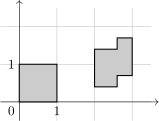
The action of by shifts: the unit square without its boundary is a fundamental domain, and so is the figure with a piece moved from one side to the other.
Here is a problem, it will go on the next sheet: which parallelograms in the plane can serve as a fundamental domain of this action? Area one is certainly needed. But a narrow rectangle – long and of small height, area one – does not work: shifting it right by one, it overlaps itself, and shifting it up leaves a gap. Good, the discussion has started – think about it.
Orbit and stabiliser: an important theorem
At some point we will need to know how many elements the group has. In algebra they will prove a wonderful theorem for you.
Theorem (Orbit–stabiliser relation). If a group is finite and acts on , then for every
Example (How many symmetries a cube has). Last time we found some monstrous number of rotations, , and something more. Let us understand how many symmetries a cube has in principle – isometries of space that take the cube to itself. is the cube, are its vertices; how they are numbered does not matter.
Take a vertex and start applying all sorts of symmetries of the cube. Where can it be mapped? To all the vertices: the cube has a very high degree of symmetry, there is always a rotation by with which you can roll it along this face, along that one, and drive the vertex anywhere. The orbit of any vertex is all eight vertices.
The stabiliser of a vertex: which isometries leave it in place? The identity transformation – obviously. Then one of the most amazing discoveries of school solid geometry: the cube can be rotated by about a diagonal, and it goes to itself; that makes three. One can also take the reflections in the planes of the diagonal sections – three more. And why are there no others? Here is what will be useful for the Platonic solids: a vertex has neighbours, three of them – three edges come out of the vertex. If the vertex stays in place, then under any transformation of the cube to itself the neighbours go to neighbours; they cannot get away from this point. In how many ways can three neighbours be sent to three neighbours? This is the symmetric group , it has six elements, and we have just realised all six: three rotations (we cyclically change the order of the neighbours) and three reflections (we swap two neighbours and leave the third alone). The stabiliser of any vertex has six elements.
By the theorem: – the most important entry of the multiplication table. Congratulations.
Regular polyhedra
What is a regular polyhedron? There are many definitions – some stricter, others weaker – but they all describe the same type of polyhedra. Each face must be a regular polygon, all of them equal; and then one has to explain somehow that everything is arranged the same way at the vertices, that it cannot be assembled sloppily combinatorially. I propose the following version, which is essentially what Sosinsky did.
Definition (Regular polyhedron). A convex polyhedron is called regular if
- all its faces are equal regular polygons;
- for every vertex its neighbours – the vertices joined to by edges – lie at the vertices of a flat regular polygon, and all such polygons (over all vertices) are equal.
The set of neighbours has a scientific name – the link – but let us not introduce unnecessary terms. When there are three neighbours, they obviously lie in one plane; but when there are five, they can go in a wave – that is why we must require flatness. Look at the dodecahedron: a vertex is facing you, three edges come out of it, and the three neighbours lie at the vertices of a regular triangle, because it is regular.
Example (A stellated polyhedron is not regular). Take an icosahedron and glue a regular tetrahedron onto each face; you get a toothy thing like this (if the pyramids are regular, all edges have the same length). Every face is a regular triangle; condition 1 holds. Let us check condition 2. A vertex at a tip has three edges, the neighbours form a regular triangle – all is well. But at a vertex of the original icosahedron ten edges meet, the neighbours lie at the vertices of a decagon, and it is not flat, it goes in waves. All such polygons are, one might say, regular, but not flat, and on top of that some vertices have a triangle and others a decagon. It is not regular – and not convex either; everything is bad.
About convexity. If it is known which faces there are and how they are glued, then a convex polyhedron is glued in a unique way – there is such a theorem; more on this later. But take the icosahedron: around a vertex there are five neighbours; you can tear off this little cap and glue it inside, push it in – it will not be convex. Someone worked hard gluing this one; I will not break it.
I was thinking about how to build the discussion of polyhedra, and I realised that I cannot bring it to a level of rigour that would satisfy me: I do not know what level of rigour you had at your schools. Roughly speaking, whichever geometry textbook you start from, two steps from it and you have a polyhedron in a completely rigorous sense; but from different textbooks the path is different, and I do not want to spend time on this. Let us gloss over this point – just as I did not give the definition of a geometry in Klein's sense: we will collect examples, then define it, and it will be clear that it is a natural thing.
Which regular polyhedra do we know? Five: the tetrahedron; the cube; the octahedron – imagine a quadrilateral pyramid made of four regular triangles put against each other so that there is a square at the bottom, and the same pyramid below; there is one lying on the cupboard over there, and it is absolutely regular by our definition – stand it on two opposite vertices or lay it on its side, it is the same from all sides, a hundred percent honest; the icosahedron; the dodecahedron. There is an interesting story connected with the discovery of the dodecahedron: it did not fit well into the Greek system of describing the world, and it was kept secret; read in Sosinsky how one of the philosophical systems of ancient Greece lived without it and how upset they were when they found out.
Other dimensions
Before proving that there are no others, I very much want to tell you how many there are in , and so on. Everyone knows what is: four coordinate axes, pairwise perpendicular; is quadruples of numbers, the scalar product is the same formula as in : ; as soon as there is a scalar product, there are lengths and angles, and all is well.
The problem is this. A polytope in has three-dimensional faces, they have faces of smaller dimension, two-dimensional ones, then edges, then vertices: the hierarchy "face, edge, vertex" gets one link longer, and in longer still. What is a regular polytope there? One can go by induction: all faces are regular polytopes of one dimension less, and the neighbours of each vertex lie at the vertices of a regular… I propose an even trickier way: to ask that the degree of symmetry be the largest possible. The meaning is very simple.
Definition (Regular polyhedron – via flags). A flag of a polyhedron in is a face, an edge in it, and a vertex of that edge; in it is a three-dimensional face, a two-dimensional one in it, an edge in that, a vertex of it, and so on. A polytope is regular if its symmetry group (rotations and reflections) takes any flag to any other flag.
For the cube: can this face be taken to that one? No problem. A face to a face and at the same time an edge on it to an edge on the other? Yes – the face goes there, and then we twist it. A face, an edge and one of the two vertices at its end – to a face, an edge, a vertex? That is possible too, reflections are allowed. This is exactly what it means that the cube has the maximal degree of symmetry: nothing more can be crammed in. And the brick we tried last time – its degree of symmetry on vertices is good, but on faces it is not: a big face cannot be taken to a small side one. So the brick is not regular in the sense that its degree of symmetry is not maximal.
The answer: in there are six regular polytopes, and unfortunately I can draw only three of them; the others do not even have names – open Sosinsky or Wikipedia, they even have pictures there. And in dimension five and higher the answer is very nice: three each – the cube, the tetrahedron (it is usually called just that, not a "hypertetrahedron") and the hyperoctahedron, which has many names: the cross-polytope and others. This theorem does not come for free, but we can easily guess now which three these are.
It is more convenient for me to describe these figures by their vertices – simply present the vertices and then take their convex hull: the smallest polytope containing these points ("we wrap a polytope around them").
Example (Three series).
- The cube in : the vertices are , the signs chosen independently, points – one in each orthant (the coordinate planes divide space into parts: in the plane, quadrants; in , octants). In the plane these are four points, in eight, and in many dimensions the same.
- The tetrahedron (simplex) of dimension is conveniently drawn in a space of one more dimension: in take the points – a one in the -th place, zeros elsewhere – that is, on each axis we step one unit away from the origin, and take the convex hull. The flat regular triangle – the tetrahedron of dimension two – is obtained this way in on three axes; take four axes and you get an honest tetrahedron; in many dimensions there are more axes, the picture is the same. It sits there very nicely, the same from all sides; one has to jump up a dimension only for the tetrahedron, the cube and the octahedron live in their own dimension.
- The hyperoctahedron in : the points – along each axis we mark one unit this way and that – and the convex hull. In these are six vertices on the axes: a triangle on top, another triangle, a triangle at the bottom, and more going off to the back – exactly that four-sloped picture. The distance between neighbouring vertices is always , the diagonal of a small square in a coordinate plane – everything is the same.
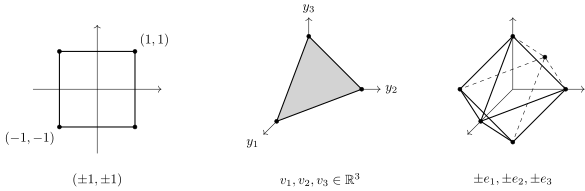
The three series by the coordinates of their vertices: the cube (here ), the simplex on axes (here a triangle in ), the hyperoctahedron (here ).
Of the six polytopes in I have drawn three for you in this way, and three, I am sorry, I cannot draw. You will construct two more on the problem sheet – the coordinates of the vertices are written out right there, and you have to check that you got what you need.
Why there are no more than five
Let us prove the non-existence theorem: if there is a regular polyhedron in , then it is only from the list. Suppose we have a regular polyhedron in .
The degree of a vertex is how many edges come out of it (the same as the number of neighbours). It is at least three: two edges can come out of a vertex, but then two faces meet and you get something flat, while we want a polyhedron. It is also bounded from above, and to see this one has to figure out what the angle of a regular polygon can be.
Lemma (The angle of a regular polygon). The angle of a regular -gon is ; in particular, it is at least .
Proof. The sum of the angles of any -gon is (not "", you are well-bred people – ; for a triangle it should come out as ). For a convex one this is easy: draw the diagonals from one vertex, and the polygon splits into triangles. That a non-convex one also splits into triangles by diagonals is a true theorem, but nobody likes to prove it. Divide by : the angle of a regular -gon equals . The more sides, the larger the angle; for large it is almost ; the smallest is for the smallest number of sides, and you cannot take fewer than three: .
How many angles can be put together at one vertex to get a polyhedral angle? The sum of the face angles at a vertex of a convex polyhedron is less than – six angles of give exactly , a flat thing; the rigorous justification depends on which textbook you studied solid geometry from, and we will slightly ignore this point. So the degree of a vertex is from three to five. Now for each degree let us find out what – the number of sides of a face – can be: we need .
- Degree : can be , or – three triangles, three squares, three pentagons; six is no longer possible, hexagons give exactly a flat thing.
- Degree : only – four triangles; four squares are already flat (I got carried away when I said it was possible).
- Degree : only – five triangles.
This is a purely combinatorial discussion, no metric reasoning: what we can in principle glue together to get a polyhedron. Glue – in the sense of a net: imagine that the surface is glued from paper, and you cut it with a razor along the edges so that it unfolds onto the plane. Let us draw the net near a vertex: three triangles are the tetrahedron near a vertex (I did not draw the fourth face); three pentagons: the angle of a pentagon is (not – is the exterior one; there, I managed), , which leaves a small gap to , and if you glue this edge to this one, you get a little cap, as on the dodecahedron, almost flat.
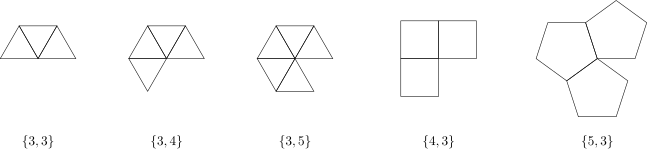
The five ways to assemble a polyhedral angle from equal regular polygons: three, four, five triangles, three squares, three pentagons. The gap to is what closes up in the gluing. The labels are the Schläfli symbols.
Are all five possibilities realised? Yes, here they are, they all exist. Let us assign two numbers to each polyhedron – the number of sides of a face and the degree of a vertex; this is called the Schläfli symbol : the tetrahedron , the cube , the octahedron – the other way round, the icosahedron , the dodecahedron . Five options, five polyhedra; the list is complete.
How many faces, and why the polyhedron is unique
We do not yet know how many faces each of them has. How awful. And a more interesting question arises – it has just come up in our conversation. The condition written as a pair of numbers is local: we discussed what happens at a vertex and on one face. Yet we claim to understand the whole structure. Why is the local data enough to reconstruct the global structure of the polyhedron – in particular, the number of faces? And why is there no other, very complicated polyhedron with the same symbol, not on the list? Probably there is none, probably they coincide, but how? Although we have not given a definition of a polyhedron, we have an idea of what it is and we use it, but we never appeal to intuitive considerations: what we write is valid for any textbook.
Why the cube is assembled uniquely from six squares: three squares around a vertex – once two neighbours are given, the third fits in uniquely; then each next face is glued in rigidly, with no alternatives, and so on around. With the tetrahedron there is no problem either: three faces around a vertex form a trihedral angle, and you have studied the trigonometry of trihedral angles, where the dihedral angles are computed uniquely; on the other side everything is the same. The octahedron is a problem for you: why, having glued eight regular triangles according to this scheme, you get a specific polyhedron, that is, for two octahedra with the same combinatorics and the same edge length there is a motion of space taking one to the other. Four triangles around a vertex are a flexible thing, it breathes; press it – it clicks and changes. As for the icosahedron and the dodecahedron – I will add it to the next sheet, since you asked this question.
Remark (The rigidity theorem). There is a general strong theorem: a convex polyhedron has only one gluing scheme – once you assemble it, its metric dimensions in three-dimensional space are rigid. Vasya took a convex polyhedron, cut it along the edges with a razor, marked what to glue to what, put it in an envelope and sent it to Petya; Petya took it out and glued the faces with tape so that it could bend – and he gets exactly the polyhedron that was there originally: because of convexity there will be no dents, and beyond that it is rigid, it does not bend.
How do we get to the number of faces? Euler's formula – it is on the problem sheet, and it will help.
Theorem (Euler). For a convex polyhedron with vertices, edges and faces
You take the alternating sum: zero-dimensional with a plus, one-dimensional with a minus, two-dimensional with a plus; for a higher-dimensional polytope one would continue – the next term with a minus, then with a plus. What you get is called the Euler characteristic; but that is a separate question, and the statement is that for a convex polyhedron it is always two. Not only for our five, but in general. The theorem is not easy, something has to be worked through; it has a more general formulation in which it is easier to prove, but on the sheet there is a version for polyhedra, which I hope you will prove. (At a certain point almost all formulas obtained by humanity were Euler's formulas: there is Euler's formula in number theory, there is one in analysis; here is another.) Knowing what can be said about the vertices and the edges, one can figure out from it how many faces there are. We will add this to the sheet too: there were seven problems, there will be nine.
Finite subgroups of and duality
There is still time; let us discuss the notion of duality and symmetry groups. There is a second point of view on a regular polyhedron: it is a figure inscribed in a sphere. What is the symmetry group of the sphere? Rotations by any angle about any axis – already infinitely many, plus the reflections in planes: the group is huge, infinite. The question: does it have finite subgroups? (A cube is not a group.)
The rotation group of the sphere is denoted – without reflections; with reflections it is the orthogonal group . I do not want to talk about now, only about rotations.
Theorem (Finite subgroups of). The finite subgroups of the rotation group other than the trivial one are of five types:
- the cyclic group , ;
- the dihedral group ;
- – elements;
- ;
- .
The plus means that only the symmetries preserving the orientation of are taken: , reflections in a plane are forbidden. (Thanks for the correction about the trivial group – a fail for me, I would not have passed the exam myself.) I will not write out the proof: it is in Sosinsky's book, long and detailed, with a tricky algebraic technique and a case analysis; there is no way to write it on the board, but it is useful to get acquainted with it – at least to understand how detailed proofs of such theorems can be.
Each type in turn.
The cyclic group . What is it concretely? A group consisting of the powers of one element; geometrically, rotations by the angles , ; there are not infinitely many of them, because values of differing by give a full turn, that is, as if no rotation had been made. Either the complex numbers , or the residues modulo – you know how to add them.
The dihedral group is by definition the symmetry group of the regular -gon. This is in the plane, and here it is interesting: flipping an -gon over in the plane is a motion of the second kind, but if you imagine dragging the whole of space along with it, it is of the first kind. It consists of the rotations by , , and reflections in axes. How do the axes run? The right answer: through the centre of the polygon and the midpoint of a side – and then there is a difference between even and odd . For odd the axis through the centre and a vertex comes out through the midpoint of the opposite side, each vertex has its own axis, and that is enough. For even the axis through a vertex and the centre comes out through another vertex, there are such axes, and the remaining must be drawn through the midpoints of opposite sides: reflections of two types. One simply has to know this, and there is nothing to worry about.
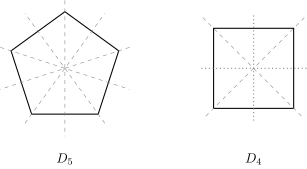
The axes of symmetry of the regular pentagon (all through a vertex and the midpoint of the opposite side) and of the square (two through vertices, two through midpoints of sides).
The three polyhedral groups. The tetrahedron has a very hefty symmetry group – , any vertex can be moved to any other; keep the orientation-preserving ones – not but elements. Then the cube and, as the vote decided, the icosahedron (the icosahedron beat the dodecahedron).
Does anything here seem strange to you? There are five polyhedra, but three groups on the list. Where is the dodecahedron, where is the octahedron? You are absolutely right: the polyhedra are related by duality. It can be understood in different ways; I will describe it purely geometrically. Look at the Schläfli symbols of the cube and the octahedron : the number of edges around a face and the number of edges out of a vertex have swapped places. That is really how it is.
Example (The cube and the octahedron are dual). Take a cube and put a point at the centre of each face: six points. Join the points corresponding to faces with a common edge: front and right – joined; front and left; top and front; left and top. We have seen this somewhere: this is the top part of the octahedron. Is that really so? The distance from the centre of one face to the centre of a neighbouring one is, by Pythagoras' theorem, times something, the same everywhere, so all the new edges have the same length. Why do we get a triangle? Because three faces meet at one vertex of the cube: the faces go round the vertex, and the chain of edges between their centres forms a face. The edges have stayed in place (to each edge of the cube corresponds an edge between the centres of its two faces), while vertices and faces have swapped roles. And conversely: the octahedron has eight faces, a four-sloped roof, the same from all sides; put a point at the centre of each face – you get a square (this can be computed by solid geometry), and since it is the same from all sides, you get six squares, arranged in the obvious way: a cube.
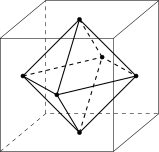
The centres of the faces of a cube, joined for faces with a common edge: an octahedron. The three faces around a vertex of the cube give a triangular face of the octahedron.
If there is a symmetry of the cube taking the cube to itself, the centres of the faces go to centres of faces – where else could they go. So the symmetry group of the cube maps to the symmetry group of the octahedron, and the groups coincide – both the groups of all symmetries and the rotation groups. The tetrahedron: the polyhedron dual to it is also a tetrahedron, only much smaller and inside; it is self-dual. The icosahedron and the dodecahedron are dual: saw off a cap of five triangles around a vertex of the icosahedron – a pentagon remains; saw off the neighbouring one – two pentagons adjoining according to the scheme, as they should. That is exactly how it is done: a vertex is put at the centre of each face, an edge is drawn for faces sharing an edge, and the five triangles around a vertex give a pentagon of new edges. So in fact these are not five groups but only three. (Duality is "sort of a transposition": faces and vertices swap roles.)
Which figure on the sphere gives and ? We have realised the three polyhedral groups explicitly as subgroups of : inscribe a tetrahedron in a sphere and rotate it – the sphere is circumscribed about it and goes to itself, so every orientation-preserving self-map of the tetrahedron is a rotation of the sphere. But what figure should we take so that its self-maps give or ? A prism? A right prism with a regular -gon as its base can be inscribed in a sphere, but besides the rotations it can also be flipped, swapping the top and bottom bases by a rotation of the sphere – that is , the dihedral group. To get just the cyclic one, the flip must be forbidden: a regular -gonal pyramid, even a hefty one, such that it cannot be flipped, only rotated. (Or paint the top face red and the bottom one blue – there is such a discussion, and we will have it when we talk about crystal lattices: you take the cubic lattice and paint some vertices black and some white – that is how a crystal of table salt is arranged – and the symmetry turns out to be trickier than that of the lattice.) And is a pyramid over a digon: two points of the sphere, not antipodal, and a spike above them – an isosceles triangle with a diameter as its base does not work (it can be rotated about the diameter, an infinite group), but a triangle over a chord that is not a diameter can only be flipped, and remains.
Thank you all for your attention; I have finished the lecture for today.
No comments yet
Be the first to share your thoughts.