September 22, 2026 · Lecture · LibreTimes
Geometry. Lecture 1
What geometries there are and what they have in common — Klein's Erlangen programme; the school 3–4–5 triangle and the ellipsoid; the cube and the brick as finite geometries; metric spaces; groups, quantifiers in the axioms; the group of bijections and the order of composition; left and right actions of a group on a set; the metrics , , on ; isometries, subgroups; the order of an element; orbits, stabilisers, transitive actions; the list of geometries in the course — the Euclidean plane, the regular triangle and , the cube and its 48 symmetries, the Poincaré model of the Lobachevsky plane; fundamental domains; subgeometries — the square in the cube.
Contents
- Literature and what this course is about
- A triangle on three sheets of paper
- The cube and the brick
- Metric spaces
- Groups
- The group of bijections
- A group action on a set
- Metrics on ℝⁿ
- Isometries
- The order of an element
- Orbits and stabilisers
- The list of geometries
- 1. The Euclidean plane
- 2. The regular triangle
- 3. The cube
- 4–8. The rest of the list
- The Poincaré disc model
- Fundamental domains
- Subgeometries
Literature and what this course is about
Our subject is called geometry, and here are the books on it worth leafing through. Book number one is Marcel Berger, Geometry: two volumes, a great deal of information, you do not need to know all of it, but some pieces are worth reading. The second book was written, as I understand it, on the basis of this course – the book by Sosinsky; its title is a little different, Geometries. There is another book whose title I do not remember by heart, but it can be identified by its authors: Prasolov, Tikhomirov. And there are recorded lectures of this course from previous years; you can play them now and then at double speed, and that will be useful too.
Why is Sosinsky's title plural – "geometries"? Because there are different ones. Which do you know? Euclidean. Lobachevsky's – it is often called hyperbolic, but since we are in Russia we call it Lobachevsky geometry; incidentally, this year is the two hundredth anniversary of his first talk: 1826, the publication came a little later, and they say the birthday of Lobachevsky geometry should be counted not from some earlier work on the fifth postulate but from 1826. Spherical. Absolute geometry is a slightly different story: in absolute geometry one throws out the axioms concerning the fifth postulate and proves theorems true in all the geometries at once; it is a narrower story. Projective. Tropical – an interesting thing, it has not been in this course before; perhaps we will say a couple of words about it. Finite geometries – the last chapter of Sosinsky's book. And an ellipsis.
Somewhere around the end of the nineteenth and the beginning of the twentieth century people had accumulated a large number of things that had to be called geometry, and they began to look at them and say: they are all different. What do they have in common? Axioms are tricky here. For example, Euclidean geometry has the notion of order of points: there are two points, and there is a point between them. Lobachevsky geometry has it too – I will draw you a picture of that today. And spherical geometry? Take a sphere, take two points, draw the line through them – and on which side do you take "between", this one or that one? And on the projective plane it is even worse. So some axioms have to be sacrificed.
In fact all these theories that we call geometries share one common feature, and the person who realised it was Felix Klein, who was only 23 at the time. He was being appointed professor, and in Germany this requires a tricky procedure, the habilitation: one must give a lecture and explain what one will bring to mathematics, a programme of future research. What he presented is now known as the Erlangen programme. And the common feature is this: a geometry has a very large group of symmetries.
In previous years this course went like this: first we define a geometry in Klein's sense, then something else. We will do it the other way round. We will first sort out all these geometries, understand what goes on in them, and only then formulate what we mean by a geometry in Klein's sense. But it is already clear that there will be some spaces, some distances, and necessarily a group that moves the whole thing around.
A triangle on three sheets of paper
When you started plane geometry at school, you probably saw something like this. The teacher says: "Children, take your double sheets and write down the problem." Everyone writes it down, makes a drawing, reasoning, conclusion. One pupil draws a triangle and computes something in it – there is a lot one can compute in a triangle. Another pupil draws a triangle and also computes something. A third, who also has a double sheet, has drawn on the right-hand side: , , . And do you know what is surprising? They all solve the problem, each on their own sheet, sitting in different parts of the classroom – and the answer is the same. Why? The triangles are drawn in different places in space: here, there, over here. And the answer is the same.
Now I will draw a strange thing. Have you ever seen an ellipsoid? A thing like this. Near one vertex you can draw a triangle with sides , , , and near another place a triangle with sides , , . They will be curved. And what matters is this: their angles will be completely different, because in this place and in that place the triangles are curved differently. Curvature – never mind how to define it rigorously – is different in these geometries, Euclidean, Lobachevsky and spherical. So here is the trick: on the ellipsoid you cannot take a piece and move it to another place, laying it down without distortion. But a sheet of paper with flat Euclidean geometry you pick up, lay it on another one – and they are simply the same. When we carried it over we did not tear the paper, did not crumple it, did nothing of the kind – and the triangles have the same altitudes, and the same medians, and everything you like simply coincides.
In all three geometries drawn here the group of isometries is very large: in the Euclidean plane any point can be moved to any place, and any two segments of equal length can be brought together by an isometry; in the Lobachevsky plane and in spherical geometry the same holds.
The cube and the brick
The isometry group need not be very large. Here are two examples; let us discuss them. On the left a cube, on the right a brick – a box whose sides all have different lengths; say, , and . How different are the symmetry groups of these figures? Very different, right? The cube can be turned around, while the brick cannot really be turned much.
We will spell out what a symmetry group is in a moment, but what I mean is this: you take a figure and apply to it a transformation that preserves distances and takes the figure to itself – not somewhere away over there, but precisely to itself. You can turn the cube like this: it has gone to itself, but the points have moved. The cube has another interesting symmetry: rotation by about a diagonal. You will not turn a brick like that. Take a thick book as a brick – it is exactly , , – and its long diagonal, from this corner of the spine to the opposite one. Try to rotate it about the diagonal so that it goes to itself. No way: you would have to rotate it by , that is, it would be the identity transformation.
But both figures are in some sense candidates for the role of a geometry. I repeat: what is very important here is that any point can be driven to any other. Of course, one cannot say that a vertex can be moved to the midpoint of an edge – that is a slippery question. The cube is determined by eight points arranged in space in a certain way, and that is why it is a finite geometry: you take eight points and transform them so that distances are preserved and these eight points go to the same eight points. Now the question: can any vertex be driven to any other? Take this one and this one. The symmetry in a diagonal plane? Agreed, but that is a transformation of the second kind, and we do not like those. But we can rotate: take the two bottom vertices and rotate the cube by about the axis through their midpoint – the two halves swap places. Now a bottom vertex to a top one: also by a rotation. You see the point? By a rotation you can drive a vertex to any neighbouring one, and then you connect the vertices by a chain of edges and walk along it. The cube has an enormous symmetry group; it has a very high degree of symmetry.
The brick is simpler in this respect. This vertex cannot be taken to this one by a single rotation – most likely you will have to take the reflection in a vertical plane; this one to this one – by flipping it over, you can after all; from here to here – apparently one needs the central symmetry. But here too all vertices are equal from the point of view of geometry: the finite geometry sitting on the vertices of the brick is also such that any vertex can be driven by a symmetry to any other. If you study something near this vertex, the same thing can be studied near that one. It is like the triangles on the sheets of paper: you learned something on one sheet, described it metrically, laid the sheets on top of each other – everything coincided. And this does not work on the ellipsoid: where it is strongly curved and where it is not, no motion will bring them together.
I deliberately do not give a definition of a geometry: once we have gained experience, we will say ourselves what it is. But on the whole the idea is this: we study certain figures, spaces, a group acts on them, and we are interested in things, notions, characteristics that do not change under the action of this group. When we study the Euclidean plane, a rule is fixed on it for measuring distance – by Pythagoras' theorem or with a ruler; that is Euclidean geometry. If you write down another rule for computing the distance between points, you may get some other geometry. Let us start writing formal definitions, or else I will just keep talking.
Metric spaces
Definition (Metric space). A metric space consists of two things: a nonempty set – so that there are points there – and a function that measures the distance between points, with three properties: for all
- , and if and only if ;
- (symmetry);
- (the triangle inequality – the most important property).
I wrote the first property a little redundantly: that the distance is nonnegative is already said by writing , but what matters is that the distance between two different points is never zero: from the metric point of view that would be one and the same point. (I do not know what the convention is: whether one may consider a metric space with no points or better not. Better not.)
Groups
Since we have said the word "group", we need to recall what it is. It has already come up in algebra, but I was told that people are not obliged to attend all the courses, so let us write it down.
Definition (Group). A group is a set with an operation , (from two elements a third is built, called their product), such that
- for all we have (associativity);
- there is an identity element such that for every we have ;
- for every there is an such that ; this is denoted and called the inverse element.
Sometimes the multiplication is replaced by a plus sign – that is when the group is commutative, you will learn about that; but it does not matter, it is an operation that builds a third element from two.
Remark (Articles). Let us stop here, and you can scold me. What did I write badly? At first I wrote the axioms without quantifiers – "", "" – and you asked: for which ? And the in the metric space were also written badly. Let me share a very important piece of information: in mathematics every noun has an article, as in English. There are two articles: there exists and for all. The article must always be there, otherwise the statement becomes completely unclear. What does the line "" without quantifiers say? Perhaps I meant that there are two such and that computing one way and the other way gives the same? If , that is of course true. So: the metric axioms hold for all , associativity for all , not just any but from . And since the order of quantifiers matters, in the identity axiom "there exists " comes before "for all ", and in the inverse axiom it is the other way round. I wrote it badly on purpose, and I did not say it when I spoke.
The axioms do not say that there is one identity element and one inverse. Their uniqueness is proved – in algebra they surely showed you this, so I will not – but it should not be put into the list of axioms. Can be empty? It cannot: it contains .
The group of bijections
Which groups do you know? You have some idea of groups, but it seems not very close to geometry. Let us describe the simplest group – it could not be simpler.
Definition (Group of bijections). Let be a set. is the set of all bijections , that is, maps that have an inverse: different points go to different points, and so on. I would have written "automorphisms", but it is unclear in which category, so I will write "bijections".
Do they form a group? If you take one bijection and then another, you seem to get a bijection again. But how do we write the operation of composition? Take and , two bijections, and we want to define . It is natural to write for every , that is, . Interestingly, the definition in Berger's book and in Sosinsky's book is different. Why? Associativity checks out, after all: write and , apply them to – it works, no problems. (Never believe me, you must never believe me: I keep writing wrong statements. For example, – how would you multiply that? There is no multiplication on , it is just a set, say the set of vertices of a cube; you cannot multiply a point of a cube by a point of a cube.)
The idea is actually this. When you apply maps one after another, first , then , you write first , then , while the composition is . We are used to drawing arrows from left to right, and so it turns out to be more natural to define multiplication in the group of bijections like this:
you take one bijection, a second bijection, first apply the first, then the second. Multiplication is not the same as composition: it is composition backwards. That is the tradition, nothing to be done; we will follow it, because I use the notation of Berger and Sosinsky.
All the axioms hold: there is an operation; associativity holds, because composition is associative however you compute it; inverses exist, because these are bijections. What is ? The identity map; it is denoted or better : whatever you apply it to, , you always get .
A group action on a set
We have a group, we have a distance. We are approaching the idea that there is some set, some structure on it, a distance, and some group acts. We need to agree on what an action of a group on a set is. Actions can be on the left and on the right.
Definition (Left and right action). Let be a group and a set. A left action of on (notation ) is a map , , such that
- for all and every ;
- for every .
A right action () is a map , , such that
- for all and every ;
- for every .
The result can be denoted however you like: , , simply – lazy people write , because it is clear anyway that has acted on . The symbol is not a function and not an arrow, just a replacement for the phrase "the group acts on the set from such-and-such a side"; there are other notations, but I like this one.
What is the difference between left and right? It is an important thing; let us spell it out. In a left action: if is acted on first by and then what came out is acted on by , this is the same as multiplying and in the group and acting by the product ; the element that acted first stands on the right in this product. In a right action: is acted on by , then by – and this is the action of the product ; the element that acted first stands on the left in the product. That is exactly the whole difference. If the group is commutative, there is no difference between left and right actions. In algebra they will prove to you that a left action in fact determines a right one; that is a certain trick, but some real formulas will be written down all the same, and we will start from them.
Example (Bijections act on on the right). There is a set and the group . It certainly acts on : take a bijection and rearrange the elements with it. From which side? We need to see how an element moves under two bijections taken in succession and how this is written in letters. Apply first , then : . But by our definition of multiplication. The bijection , applied first, ended up in first place in the product – this is a right action. So we will write the map to the right of the point: , and then .
There is no deep idea here; it is just a form of notation; one should treat it as a kind of game with the text – we played it this way, and nothing substantive has happened yet. We will easily survive a bit of the exotic.
Metrics on
What is ? Not Euclidean space, but simply the set of tuples of real numbers separated by commas: write real numbers in a row and you get an element of . Then we can agree on what to do with them: add them, multiply them by numbers – but the vector space interests us little right now. What interests us is how to compute the distance between two points. If I do not write an index, I mean a point: , .
Example (Three metrics on).
- The sum of the absolute values of the coordinate differences:
For this to vanish, all the summands – absolute values – must be zero, that is, all the coordinates are equal and the points coincide. The triangle inequality holds because for each individual one writes down a triangle inequality; you will check this yourselves, there will be an exercise.
- As you were taught at school, by Pythagoras' theorem:
I wrote the absolute value because instead of the two one can put any power : ; with a square round brackets would do, but if you want to write a cube you would have to watch the sign, hence the absolute value, so as not to make a mistake in the future.
- The maximum of the coordinate differences – a formula I also like very much, and I think it will be useful to us:
This is as , which is why it is called .
That these really are metrics can be checked: symmetry and non-degeneracy are more or less obvious, while the triangle inequality is substantive work that has to be done. What about the minimum of the differences? The minimum will not be a metric: if one pair of coordinates coincides, the minimum will be zero, while the points are different.
An example in the plane: the points and . Horizontally they are two squares apart, vertically one. . – it turns out that can be drawn on squared paper: two squares this way, one that way; try to figure out at home whether and can be drawn. .
Isometries
Let be a metric space. The group of bijections contains a subgroup called the isometry group of the metric : .
Definition (Isometry). A map is called an isometry of the metric space if
- is a bijection;
- preserves distance: for all .
Why the condition that it is a bijection? I sense a question from you. Take the half-line with and – shift it one step towards infinity. It preserves distance, condition 2 holds, but it is not a bijection: this map has no inverse, and it is not an isometry. (Again the definition was written illiterately – without "for all ". Well done for noticing.)
Inside the group there is a subgroup – let us explain what a subgroup is, we have a bit of time, we are in no hurry.
Definition (Subgroup). Let be a group and a nonempty subset. is called a subgroup if
- for all their product , computed in , belongs to ;
- for every the inverse , computed in , belongs to .
has a multiplication; the elements of are also elements of , they can be multiplied, and we would like to stay inside . Should we ask that ? It follows from the two conditions – but only if is nonempty. There is a little glitch in this definition, and people usually forget to mention it: the empty set obviously satisfies these two properties, and we would get a subgroup without an identity element. A group consisting of the identity alone exists, but this would be uncomfortable. Hence: nonempty.
Why do isometries form a subgroup of the bijections? Take one transformation – distances are preserved, take a second – preserved, nothing got distorted; the inverse of a distance-preserving map also preserves distances. In principle one can write a formula – write it yourselves: when you hand in your problem sheets, the assistants will ask you.
The order of an element
In the context of isometries, let us formulate a few definitions we need to know.
Definition (Order of an element). The order of an element of a group is
if there is no such , that is, for every , we put .
The definition has two parts. The first: you grab natural numbers and compose with itself times; if at some point you get the identity element, you take the smallest such and say that it is the order. The second: if, having tried all natural numbers, you never got the identity, it is natural to say that the order is infinite. That is, the order is how many times an element of the group must be multiplied by itself (or added to itself, if the operation is written additively) to get the identity element.
Example (Orders of transformations of figures). We are talking about elements of a group, but we are thinking about transformations of figures.
- A square and the rotation about its centre by : the vertices are permuted cyclically; rotate four times – as if nothing had been done. One, two, three times – a non-identity transformation. The order is four.
- A circle and the rotation by the angle – a radian, not a degree. The order is infinite: the number , which is responsible for bringing the circle onto itself, and are incommensurable. (And by the order is .)
- A line and the shift by one to the right: – you will never get the identity. The order is infinite.
When we get to geometric figures, we will see that this is really everything.
Orbits and stabilisers
Two more notions, and here the context changes: now we are talking about a set on which a group acts. I will write the action on the right, because I use the notation of Berger and Sosinsky; it is a convention about the order in which to write the letters, and for now it does not matter to us.
Definition (Orbit and stabiliser). Let and .
The orbit of the point is the set : take and start acting on it by all elements of the group; starts, informally speaking, to smear out over the space , to multiply. What you get is the orbit.
The stabiliser of the point is the set of those elements of the group that do nothing to .
Example (Four rotations of the plane). , – the identity and three rotations about a point by , , (our favourite rotation by and its powers). Since I am defining an orbit, I must say which set and which group, otherwise it would be cheating.
The orbit of the point : you act, act, act – you always get . The orbit consists of one element. Take a point and rotate it: one, two, three, and you come back. The orbit of is four points located at the vertices of a square (the square itself is not the orbit, only its vertices).
The stabiliser of the point is only the identity: all the others start dragging it across the plane. The stabiliser of the point is the whole group: does not go anywhere at all.
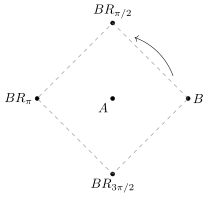
The orbit of the point under the group of four rotations about : four points at the vertices of a square. The orbit of itself is a single point.
If you take not but, say, , there will be rotations, and the orbit will consist of points.
Lemma (The stabiliser is a subgroup). is a subgroup of .
Proof. The identity element is certainly there. If one element leaves in place and another leaves in place, then their composition in either order leaves in place. The inverse: let ; is it true that ? The trick is this: who knows, maybe not. But is a bijection, so instead of comparing and , let us compare their images under : and . The images coincide – so the points coincide; a bijection preserves coincidence.
The inverse element is not necessarily its own inverse: the other points still move somehow. And why does each element of the group act by a bijection? Could different points go to one point? No: acting by the inverse element, we must come back to the original points.
When you take a big group and start taking different points and looking at how their stabilisers and orbits are arranged – that is very beautiful geometry, but in the context of our subject it will be somewhat set aside, because we will be interested in transitive actions.
Definition (Transitive action). An action is called transitive if for any two points there is a such that .
That is, any point of can be moved to any other point of ; there will be one orbit. This is exactly what it means for our geometric figure to have a very high degree of symmetry; that is where we started: the cube – take this vertex and this one, and here is a transformation that moves one to the other, and so for every pair.
One more useful property of orbits. Can orbits intersect? Take the orbit of , take the orbit of , and suddenly their intersection turns out to be nonempty. It follows that the orbit of simply coincides with the orbit of : orbits either coincide or do not intersect at all. This is a simple exercise on the associativity of the action; I leave it to you. If there are questions left in a week, we will come back and I will show the proof, but better check it yourselves.
The list of geometries
Time to get closer to reality. Let us talk about the list of geometries that will interest us. The point is that there is a metric space on which an interesting group acts on the right by isometries. There are uninteresting ones too: what is the isometry group of a triangle with sides , , ? Trivial, it cannot be turned in any way, so from the point of view of Klein's geometry it is an object of little interest. But an equilateral triangle is very good: its symmetry group is huge, you can rotate it, you can reflect it, it is a highly symmetric object.
1. The Euclidean plane
with the Euclidean distance – the square root of the sum of the squares of the coordinate differences. The isometry group is the group of motions of the plane. Some schools even teach their list: translation, rotation, reflection in a line, and glide reflection – the composition of a reflection in a line and a shift along this line (not sideways, but along it). We will apparently have an exercise to prove that however you multiply these things, you still get a motion from the same list – but not this time.
1′. with the same metric . The list of motions there is trickier, the isometry group is organised in a more complicated way, and it can no longer be written down in words like that; we will not write anything here.
2. The regular triangle
One can think about the triangle in different ways: as three points, as a figure made of vertices and edges, as a part of the plane; the metric is Euclidean, so that the distances are equal. The isometry group of all three is the same: , the group of permutations of three elements. Why? After all, the triangle has a certain shape: for it to go to itself, a vertex must go to a vertex; you cannot rotate it so that a vertex goes somewhere else (a slightly informal consideration). Since everything is determined by the vertices, we only need to keep track of the order in which they are permuted. If round the cycle, it is a cyclic permutation; if a reflection, a transposition.
For accuracy let us write out the list. Label the vertices counterclockwise.
- is the identity element;
- is the rotation about the centre by (), ;
- is the rotation by the other way; but this is , because the rotation has order three: rotating twice gives the angle , and as a rotation that is the same as the other way;
- , , are the reflections in the axes through the vertex , , respectively (and the midpoint of the opposite side).
The rotation here is about the centre, not about a vertex: we turn it so that vertices go to vertices; the axis goes through the centre perpendicular to the plane. As for why there are no others – let me show my cards in advance, you will have that question. (The regular -gon is on your problem sheet.)
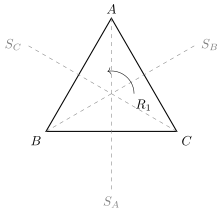
The regular triangle: the rotation by about the centre and the three axes of symmetry , , . Together with and , the six elements of the group .
3. The cube
Our favourite cube. It has eight vertices; there are permutations of eight elements – a great many. But the symmetries of the cube, the transformations of the cube to itself preserving the metric, are actually not that many; their number is perfectly manageable. Let us describe them in words.
Let us start with the rotations.
- About an axis through the centres of opposite faces: three nontrivial rotations (we do not count the identity for now), three axes – elements.
- About a main diagonal. This is an amazing discovery that every schoolchild makes: if you look at the cube along a main diagonal, it projects onto a regular hexagon. Rotation by : two nontrivial rotations about each axis; each vertex of the top face has its own diagonal through it, so there are four axes – elements.
- About an axis through the midpoints of opposite edges, by the angle : you take the cube by the midpoints of the edges and flip it over. There are six axes – elements.
, plus the identity: rotations. I assure you that a composition of rotations is an orientation-preserving transformation, that is, again a rotation: composing these things with each other, you will not jump out of the list. Where do we get the remaining (someone said )? You take a transformation of the second kind, one that reverses orientation – the reflection in a plane parallel to a face – and multiply it out with these rotations. Another symmetries, elements in all.
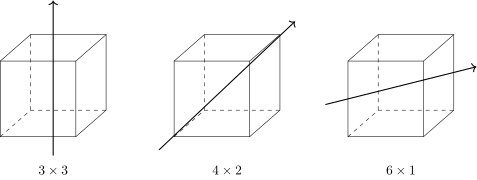
The three types of rotation axes of the cube: through the centres of opposite faces (three axes, three rotations each), the main diagonals (four axes, two rotations each, by ), through the midpoints of opposite edges (six axes, one rotation each, by ). With the identity, rotations; with the reflections, symmetries.
4–8. The rest of the list
Next come the discrete geometries, of two types: 4. kaleidoscopes and 5. Fedorov geometry. Then the non-discrete ones: 6. the Lobachevsky plane, 7. projective geometry, 8. the geometry of the sphere. The triangle earned a separate place in the list for methodological reasons: on it I had to show how the elements of the group work; otherwise it is small.
The Poincaré disc model
A couple of words about the Lobachevsky plane – I will show a very simple model. Take an open disc – we do not take the boundary. The boundary is called the absolute. As lines we take arcs of circles that hit the absolute at an angle of (we do not take the endpoints), and also diameters. Such things in this model – the Poincaré disc model – are called lines of Lobachevsky geometry. A geometry has points, lines, rules for measuring angles, rules for measuring lengths and a list of axioms all of this has to satisfy. We will measure angles as Euclid does: when two circles intersect, you know the angle between them. And the length of a segment is computed by a tricky formula – a complicated formula.
The trick is that in this picture all the axioms you have seen in school geometry hold, except the last one: through a point off a line one can draw many lines that do not meet the given one. Take a line and a point off it. There are two limiting lines – circles that touch our line at its endpoints on the absolute (and also meet the absolute at an angle of ). And between them there is a whole pencil of circles through our point: as if you turn it, swing it – and you get a whole bunch of lines that do not meet the original one. At the same time this geometry has the sine theorem, the cosine theorem, the criteria for congruence of triangles, medians, bisectors – everything you have seen in school geometry, it is all there.
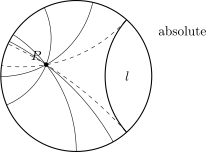
The Poincaré disc model: a line (an arc perpendicular to the absolute), a point off it, the two limiting lines (dashed) and a pencil of lines through that do not meet .
Fundamental domains
To finish, I will give two more definitions that appear on the problem sheet.
Definition (Fundamental domain). Let a group act on ; one should think of as a part of the plane or of space, otherwise something odd results. A fundamental domain is a domain (an open connected subset; for simplicity, in all our examples it will be the interior of a polygon or a polyhedron, so as not to worry about where the boundary is) such that
- for every , ;
- .
That is, you take a part of the figure, an open set, and apply to it all your isometries, the full list; shifting by a nontrivial element gives something new that does not intersect the old (for there will of course be an intersection). And if you take all the shifts over the whole group and take the closure – add all the boundaries – you must get all of . Connectedness means any two points can be joined by a broken line; for domains in the plane this is the same as connectedness in the general sense – a tricky theorem, but the same thing. A fundamental domain is not defined in every situation, but nevertheless.
Example (A fundamental domain of the triangle). Take a genuine flat regular triangle; its isometry group acts on it – I very much wanted to write , but it is , of course, with six elements. Which part of the triangle should we take so that rotations and reflections tile the whole triangle with it? Cut it by the medians into six pieces; one small piece, considered without its boundary, is a fundamental domain: by a reflection – hop, here; by a reflection – here; or you can roll it around by rotations, there are many ways. Applying all six elements of the group to it, you get all six pieces: five nontrivial ones and the original one, corresponding to the trivial element.
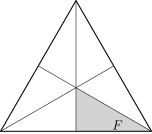
A regular triangle cut by its medians into six pieces. The shaded piece without its boundary is a fundamental domain for the action of : its six images are exactly the six pieces.
Subgeometries
We have not yet given the definition of a geometry in Klein's sense, but I already want to say what a subgeometry is. You have a metric space on which a group acts by isometries, and another space on which another group acts (I chose rather than because was some subgroup). I want to agree on what a map from one to the other is: so that the set goes to the set and the action is preserved. We need two maps: and .
Definition (Morphism of actions and subgeometry). A pair of maps , preserves the action if for all and
you can apply to and then – you land in ; or you can send to right away, send to and act there. The results must be equal. is a subgeometry of if, in addition, is an embedding of sets and is a monomorphism of groups.
A homomorphism from a group to a group is a map compatible with the operations: (like a ring homomorphism, only with one operation). A monomorphism is a homomorphism with no kernel: if , then . That is, if you took some element, applied and landed on the identity of the group , then the one you started from was also the identity; this is not always the case. A monomorphism is an embedding as sets.
Example (The square in the cube). The geometry of the square is realised as a part of the geometry of the cube: the square can be put into the cube isometrically onto some subset in such a way that the symmetry group of the square is realised as a subgroup of the symmetry group of the cube. Where does this little square lie? Not just anywhere: if you put it in at random, the symmetry of the square that swaps these two vertices and these two will throw the cube somewhere. You need to put the square on a face of the cube – that option works. Here everything is completely clear: both groups are realised as subgroups of the motions of , and whichever way you turn it, it all works out.
I have already run over by a few minutes. A break, and then the seminar.
No comments yet
Be the first to share your thoughts.