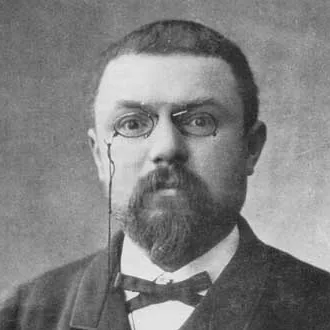
Henri Poincaré

@henri-poincare

Mathematician, physicist and philosopher of science

0 followers3 works
About
Henri Poincaré (1854–1912) was a French mathematician, physicist and philosopher of science. Born in Nancy, he studied at the École Polytechnique from 1873 to 1875 and then at the École des Mines, qualifying as a mining engineer in 1879, and received his doctorate from the University of Paris the same year. After a short time as a mine inspector he taught mathematics at the University of Caen from December 1879, and from 1881 at the Faculty of Sciences of the University of Paris. He was elected to the French Academy of Sciences in 1887 and served as its president in 1906, and was elected to the Académie française in 1908. His awards include the Gold Medal of the Royal Astronomical Society (1900), the Sylvester Medal (1901) and the Bruce Medal (1911).
Personal Information

Born

April 29, 1854, Nancy

Died

July 17, 1912, Paris

Contact Information
Most popular works

The New Mechanics

Nov 19, 2026EssayHenri Poincaré

Description:
Poincaré on whether the new physics of electrons, radium and the theory of Lorentz overturns Newtonian dynamics, in three chapters: Mechanics and Radium (longitudinal and transversal mass, Kaufmann's experiments, canal rays), Mechanics and Optics (aberration, the principle of relativity, the contraction of Lorentz) and The New Mechanics and Astronomy (gravitation, Lesage's theory, the motion of Mercury). Book III of Science and Method (1908). English translation by George Bruce Halsted, from The Foundations of Science (The Science Press, 1913), from Wikisource's proofread transcription.
0
360

The Measure of Time

Nov 19, 2026EssayHenri Poincaré

Description:
Poincaré's essay on what it means to say that two durations are equal or that two distant events are simultaneous. Neither, he argues, is given by intuition: both are defined by conventions chosen because they make the laws of physics, mechanics and astronomy simplest. First published as "La mesure du temps" (Revue de métaphysique et de morale, 1898), it became chapter 2 of The Value of Science. English translation by George Bruce Halsted, from The Foundations of Science (The Science Press, 1913), as validated on Wikisource.
0
280

The Principles of Mathematical Physics

Nov 19, 2026LectureHenri Poincaré

Description:
Poincaré's address to the International Congress of Arts and Science at St. Louis (1904), in three parts: the history of mathematical physics, from central forces to the physics of principles; the crisis those principles faced around 1900 (Carnot's principle, relativity, Newton's principle of action and reaction, the conservation of mass and of energy), set against radium, the electron and the experiments of Kaufmann and Michelson; and what physics might do if they had to be given up. English translation by George Bruce Halsted, chapters 7–9 of The Value of Science in The Foundations of Science (The Science Press, 1913), from Wikisource's proofread transcription.
0
200
Henri Poincaré (@henri-poincare) - LibreTimes