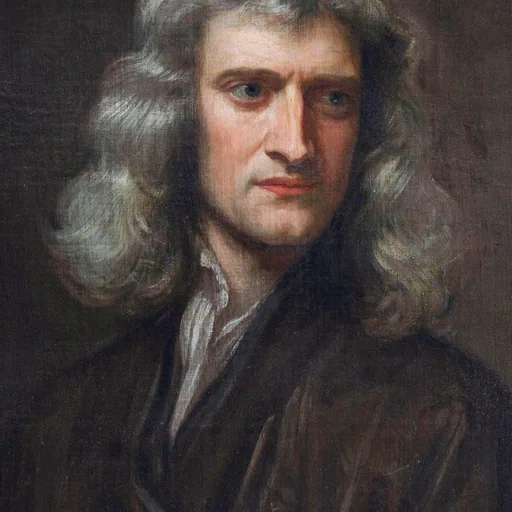
Isaac Newton

@isaac-newton

Mathematician, physicist and astronomer

0 followers2 works
About

Isaac Newton (1642–1727) was an English mathematician, physicist and astronomer. He was admitted to Trinity College, Cambridge, in 1661, took his BA in 1665 and his MA in 1668, and in 1669 became Lucasian Professor of Mathematics at Cambridge, a chair he held until 1702. His Philosophiæ Naturalis Principia Mathematica was published in 1687. He was elected a Fellow of the Royal Society in 1672 and was its president from 1703 until his death. He sat in Parliament for the University of Cambridge in 1689–1690 and 1701–1702. In 1696 he moved to London as Warden of the Royal Mint and was its Master from 1699 to 1727. He was knighted in 1705.

Personal Information

Born

December 25, 1642 (Julian calendar), Woolsthorpe-by-Colsterworth

Died

March 20, 1727 (Julian calendar), Kensington

Contact Information
Most popular works

Philosophiæ Naturalis Principia Mathematica

1687BookIsaac Newton

Description:
Newton's Mathematical Principles of Natural Philosophy, in which he states the three laws of motion and the law of universal gravitation and derives from them the motions of the planets, the comets, the Moon and the tides. Three books: the motion of bodies, the motion of bodies in resisting media, and the system of the world. This is the first edition (London, 1687), printed by Joseph Streater for the Royal Society with Edmond Halley seeing it through the press, here as a scan of the Boston Public Library copy.
0
1400

A Letter of Mr. Isaac Newton, containing his New Theory about Light and Colors

Nov 19, 2026EssayIsaac Newton

Description:
Newton's first published paper (Philosophical Transactions 6, no. 80, 19 February 1671/72, pp. 3075–3087), sent to Henry Oldenburg for the Royal Society. From his prism experiments, the experimentum crucis among them, he argues that white light is a mixture of rays that are differently refrangible, each with its own colour, and from this explains the colours of prisms, the rainbow and natural bodies and why refracting telescopes cannot be perfected. Text of the original printing, from Wikisource's proofread transcription, checked against the scan.
0
130